
A new chapter for Cornwall’s wild rivers: beavers return

A new chapter for Cornwall’s wild rivers: beavers return

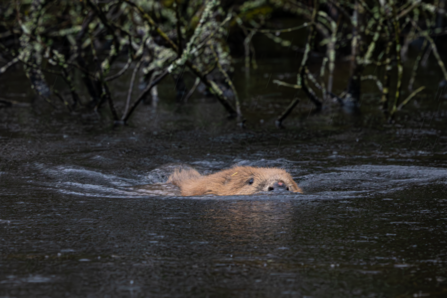
A beaver exploring after release © Beaver Trust

In a landmark moment for nature recovery, Cornwall Wildlife Trust has reintroduced beavers to the wild for the first time. Cheryl Marriott, Director of Nature and People, shares how the project came to life, and what a future alongside beavers could look like.

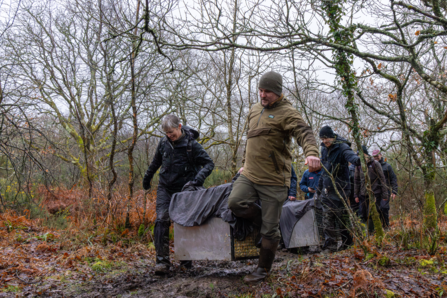
An ache across both shoulders is a welcome reminder that it really did happen. On a wet February under licence from Natural England and assisted by the Beaver Trust, we released the first of several pairs of beavers into the wild, high up in the River Par catchment in mid-Cornwall. My shoulder ache comes from helping to carry a heavy steel crate containing a 20kg Eurasian beaver along a slippery, muddy path, to the edge of a pond. 

We opened the male beaver’s crate first. He tentatively took to the water and dived down with a tail-slap. The more confident female followed and immediately started to explore. We hope they will pair up and choose to stay, but it is their choice. This time, there are no fences.
How I became a beaver believer

I haven’t always been a beaver believer. When wild release was first proposed for Cornwall back in the early 2010s, I knew very little about beavers. I promptly wrote a list of species I thought might be negatively affected if their habitat was lost under a pond, or if the tree they roosted in was felled.  I was aware of beavers’ cartoonish reputation for building leaky dams on small streams and gnawing through trees. 

What I didn’t realise then was that beaver dams can create impressive new wetlands, and that the tree gnawing is mostly of willow (that re-shoots soon after) and that beaver coppicing brings light and dynamism into otherwise bland habitats. 

Beavers are referred to as a ‘keystone species’ because their activities create a world of opportunity for others: amphibians, birds, plants, small mammals, moths and dragonflies have all been shown to fair better with beavers around. 


We are learning more all the time. Much of the research comes from Europe, where the small at-risk populations that survived over-exploitation have recovered and expanded. To date, 27 countries have brought beavers back. A recent study in Poland found that bird species diversity and abundance was significantly higher within beaver territories than outside. There was even a ‘spill-over effect’, with the positive impact being detected up to 80 metres away from the beaver ponds. 

We now know that beaver dams hold back water across landscapes and this can reduce down-stream flood-risk and help to keep rivers flowing during drought. Silt settles out in beaver ponds which means the water runs cleaner after flowing through a beaver territory. There is a lot to like about these hard-working mammals. 


Taking the first steps to wild beaver release

The early work of the pioneering beaver conservationists, a growing stack of peer-reviewed university research, and firsthand learning from the Woodland Valley Farm fenced beaver trial near Truro eventually convinced us to take the plunge. 

In 2023, with generous ‘no-strings attached’ funding from St Eval, an environmentally minded candle company in North Cornwall, we hired our first Beaver Officer, Lauren Jasper. Lauren teamed up with our Ecologist Laura Snell, and two years of door-knocking, consultation and paperwork began. Our long-awaited licence came through at the end of January 2026.

Having open conversations with the community was crucial

In our discussions locally, we found most householders, farmers, land managers and infrastructure managers are cautiously positive. They can see where we are coming from, that there are catchment-scale, society-wide benefits to be had. 

We have interests in common. We all want to see wildlife recover, for downstream flood risk at Par and St Blazey to be reduced and for our streams and wetlands to be more resilient to climate change. We discussed the potential challenges and solutions with them and made clear our commitment to help deal with any issues quickly.

We were encouraged by these conversations, but inevitably not everyone is enthusiastic about the prospect of sharing the landscape with beavers. The few who are vocally against the idea often have perfectly legitimate concerns. They feel their interests are under threat in some way, and/or they are frustrated by the sheer audacity of it.  

Sometimes a lack of understanding means their concerns are unfounded - we have had people worried about dams being built on main rivers for example, and when we explain that damming will be confined to the smaller streams they are immediately reassured. I often remind myself of my own concerns about beavers 15 years ago and try to see the situation from other people’s shoes.

This is a big change that will take some getting used to, especially as we are the species that has been calling the shots for the last few centuries. 
 

What does a future with beavers look like?

Undoubtedly there will be bumps in the road ahead, but that isn’t a reason to not do a reintroduction - it is a reason to do it responsibly. Natural England understand this and have attached a series of conditions to our licence that commit us to keeping an eye on the beavers and their future young for the next decade at least, and to support anyone impacted by their return.

Journalists like to ask what success looks like over the next five to ten years. To me it is the beavers pairing-up, settling into their new territories, having young and being left alone to do what they do best. 

Alongside this, I hope we’ll see a collective mindset develop that accepts beavers as our allies, rather than viewing them as adversaries. 

Yes, it has been a long time since we co-existed. Yes, the landscape is very different now compared to when beavers were here in numbers. But if we share skills and knowledge, if we collaborate and innovate to overcome the challenges, then we can definitely live alongside beavers successfully again. 


More about our wild beaver release

We were so delighted to work with Beaver Trust to release two pairs of beavers on 9 February and we look forward to monitoring how they settle in.

Dr Roisin Campbell, Head of Restoration at Beaver Trust, said: “This release builds on years of collaboration between Beaver Trust and Cornwall Wildlife Trust, with coexistence, local engagement and long-term management central to the approach.

“We hope this marks the beginning of restoring the species at the scale needed in the wild to halt species decline, increase wildlife, and ultimately tackle the biodiversity crisis, in line with the government’s legally binding commitments.”

Read the full story