

John MacPherson/2020VISION
How to identify whales and dolphins
What are whales and dolphins?
Whales and dolphins are marine mammals. Along with porpoises, they belong to a group known as cetaceans. They spend their whole lives in the sea, surfacing periodically to breathe air through a blowhole.
Which cetaceans am I likely to see?
The UK is an excellent place for cetacean spotting. Around 30 species have been recorded in our seas, though only a few are seen regularly. You're most likely to spot harbour porpoises, bottlenose dolphins and common dolphins. Whales are regularly recorded, particularly minke whales in late summer.

Harbour Porpoise ©Niki Clear
Harbour porpoise
Our most common cetacean, found all around the UK and regularly seen from the shore. Usually alone or in small groups. Very small and dark, with a stubby, triangular dorsal fin. They can be tough to spot as they barely break the surface.

Bottlenose dolphins ©John MacPherson/2020VISION
Bottlenose dolphin
Regularly spotted around Scotland, northeast and southwest England, the Irish Sea and Alderney. A large dolphin with a short 'bottle-shaped' beak, tall, curving dorsal fin and uniform pale grey back with a lighter belly. Usually in small groups. Playful, often leaping from the water and swimming next to boats.

Chris Gomersall/2020 VISION
Common dolphin
Often seen around southwest England, in the Irish Sea and around the west coast of Scotland. Occasional elsewhere. A small, slender dolphin with a yellow and grey hourglass pattern on its sides. Forms large groups. Fast and energetic, often surfing the waves from boats.

Risso's dolphin ©Eleanor Stone
Risso's dolphin
Mainly seen around Scotland (particularly the Hebrides), the Irish Sea and Cornwall. A large, stocky dolphin with a tall, curved dorsal fin and a blunt, bulbous head. It has a grey body covered in paler scarring, sometimes becoming white. Usually in small groups. Often leaps from the water.

White-beaked dolphin ©John Carnell
White-beaked dolphin
Mostly seen off northeast England, Scotland and around Lyme Bay. Most sightings from land are in late summer. A large, robust dolphin. It's black with distinctive white flashes on the flanks and behind the tall dorsal fin. Usually in small groups. Often leaps from the water.

Orca © Chris Gomersall/2020VISION
Orca
Mostly around northern and western Scotland, occasionally in the Irish Sea, off southwest England and eastern Scotland and England. A huge, stocky dolphin with a tall dorsal fin. Distinctively black and white, with a white, oval eye patch and a grey patch behind the dorsal fin. Usually in small groups.

Minke whale ©Amy Lewis
Minke whale
Most common around Scotland, eastern England and in the Irish Sea. Often seen in late summer. A small, grey whale. It has a relatively small, curving dorsal fin two thirds of the way along its back. If seen closely, the white band on each flipper is diagnostic.
Rarer cetaceans

Humpback whale (c) Richard Shucksmith/scotlandbigpicture.com
Humpback whale
Sightings increasing around the UK, particularly Scotland, the northern North Sea and southwest England. A robust, dark whale with a knobbly head and long, wing-like flippers. It blows out a tall, bushy plume of water when it surfaces. Has a habit of raising its tail before a deep dive.

Long-finned pilot whale © Amy Lewis
Long-finned pilot whale
Common in the deeper waters to the north and west of the UK, but rarely seen from land. A shiny black whale with a bulbous head. The low dorsal fin is two fifths of the way along the back. It has a wide base and sweeps backwards, sometimes appearing hooked.
Not a cetacean!
A large, dark shape breaking the surface of the sea might not be a ceteacean. It could be a seal, a bluefin tuna, the triangular fin of a basking shark, the flappy fin of an ocean sunfish or (if you're very lucky) even a leatherback turtle!

Grey seal © Chris Gomersall/2020VISION
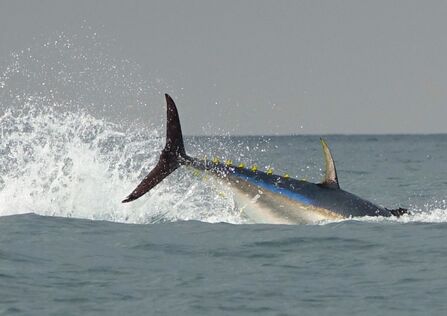
Bluefin tuna © Rupert Kirkwood

Basking shark © Chris Gomersall/2020VISION
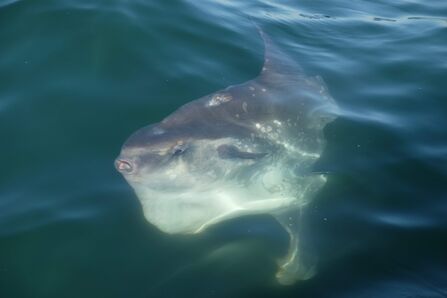
Ocean sunfish © Bex Lynam
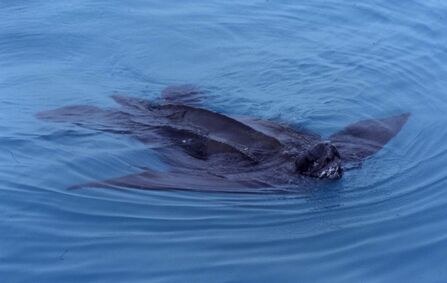
Leatherback turtle ©Mike Dains

Mark Hamblin/2020VISION
As a charity we rely on memberships
Memberships help us campaign for better protection and management of our seas.

Mark Hamblin/2020VISION
Seas in crisis
Learn about the threats facing our seas and how we're tackling them.