
Farmers working together for nature’s recovery

Farmers working together for nature’s recovery

Farmer Clusters are a great way of farmers sharing knowledge to support soil health, water quality support nature recovery while maintaining productive, resilient farm businesses. Ian Stevenson, Land Advice Service Manager, explains more about their importance.

Farmer Clusters are a farmer-led initiative 

The first Farmer Cluster concept in England was established on the Marlborough Downs in Wiltshire. Following this, funded clusters were rolled out in 2014. Farm clusters are simply groups of neighboring farmers working together to share knowledge and coordinate action across a landscape. Supported by a facilitator, they focus on improving soil health, water quality, agri-environment agreements, and on-farm habitats, which are essential to keep a farm business viable and resilient. Working as a group also opens doors to new public and private funding that is out of reach for a single enterprise. 

Generally, clusters start from the ground up, with farmers getting together, identifying local priorities, choosing a lead farmer and selecting a facilitator. The advantage of Farmer Clusters is that they are a farmer-led, peer-to-peer approach. This creates an opportunity for farmers to learn from each other, see real-life case studies, and tap into the knowledge of a broad range of experts. 
 

They provide opportunities for farmers to learn from one another 

Farmers have consistently placed the highest value and credibility on information gained from other farmers in similar contexts (i.e., similar soil types, climate, and farming types). Much like the Wildlife Trust movement, a farm cluster has a place-based approach. Trusted expertise in a local context is more likely to lead to successful implementation than more formal or less personal approaches.  

Farming can be an increasingly isolating profession with limited opportunity to catch up with friends and neighbours. Clusters create vital support networks that also create a space to discuss shared challenges such as funding availability, spiraling costs, climate impacts, the compliance burden, and much more. It is vital that there is continuing government funding to support clusters, which play a vital role in rural communities and the farmed environment.  
 

Clusters focus on local, shared environmental challenges

Advice and training sessions within clusters must be tailored to the needs and interests of the farmer group. They should be practical, relevant, and grounded in the realities of farming and the lived experiences of those who manage the land. They should include on-farm walks and demonstrations to see how things work in a real-life context.  

Working as a group also helps farmers to share costs, such as for specialist expertise, bulk buying seeds and even sharing the cost of machinery.  
 

Farmer Clusters have achieved so much for nature 

Achieving nature’s recovery means actions need to be coordinated over large areas, which just wouldn’t be possible for single farms acting in isolation. Often the Farmer Cluster model doesn’t end with advice and agri-environment support.  

A number of clusters have grown into large landscape-scale initiatives that have attracted significant backing from government and private finance. These have included Landscape Recovery projects, Natural Environment Investment Readiness Fund (NEIRF) grants to test private nature markets, and supply-chain initiatives like Landscape Enterprise Networks (LENs) which trade environmental outcomes with corporate buyers. By aligning their efforts with Local Nature Recovery Strategies (LNRS), these groups are proving it is possible to unlock public and private investment for nature recovery. 

There are now estimated to be more than 220 cluster groups in England, which cover at least 450,000 ha and involve thousands of farmers and landowners. The real figures are likely to be much higher, and work is underway with a partnership of organisations to map the true current extent of this initiative. 
 

How can Farmer Clusters be funded? 

Many clusters fund their activity through Natural England’s Countryside Stewardship Facilitation Fund. These three-year contracts cover facilitation, training events, and core administrative expenses. However, navigating the paperwork and reporting structures of the fund has historically been a challenge for groups. 

Other farmer clusters use Farming in Protected Landscapes (FiPL) funding (where available), while some tap into utility companies or corporate supply-chain partnerships, such as through food manufacturers. Some are funded by local authorities for specific outcomes, and some are supported by charitable Trusts. Alternatively, some clusters choose to partly or entirely self-fund through individual farm subscriptions to maintain independence and a lower compliance burden. 

The new government scheme is called the ‘Farmer Collaboration Fund’. This competitive fund will similarly support the costs of running groups and providing specialist technical advice. However, it will be structured differently, with regional 'Delivery Partners' playing a central role in managing the fund and supporting networks on the ground.

How do The Wildlife Trusts support farm clusters? 

Wildlife Trusts are involved in around 40 Farmer Clusters, by facilitating them, working in partnership, or providing nature recovery advice and training to existing groups.  

Let's look at just a few of them. 
 

Ray Farmer Cluster 

Berkshire, Buckinghamshire and Oxfordshire Wildlife Trust works in partnership with other organisations to support the Ray Farmer Cluster, which was formed recently following a landscape-scale feasibility study.  It brings together over 40 landowners and farmers across the River Ray catchment in Buckinghamshire and Oxfordshire. 

The cluster focuses on landscape-scale conservation, regenerative agriculture, and restoring biodiversity along the River Ray catchment. Early projects included supplementary feeding of farmland birds, restoring rare floodplain meadows, re-linking fragmented hedgerow networks for rare butterflies, and implementing soil-friendly regenerative practices that protect the River Ray catchment. 
 

Arden Farm Wildlife Network 

The Arden Farm Wildlife Network was established in 2018, as a partnership between Warwickshire Wildlife Trust, Warwickshire Rural Hub, Severn Rivers Trust and independent agricultural advisers. It features 56 members managing approximately 13,500 hectares to boost wild bird and pollinator habitats. This active network brings farmers together to improve biodiversity across the Arden landscape. 

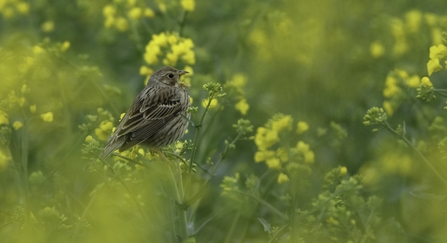
The cluster focuses on landscape-scale projects, linking the efforts of individual farmers to create bigger, better and more joined-up natural habitats that support farmland birds, pollinators and mammals. The group aims to upskill and empower its members, enhancing farm resilience and promoting sustainable practices. The work of the cluster benefits species like corn bunting, lapwing, brown hairstreak and lesser horseshoe bat. 
 

Wylye Valley Farmers 

Wiltshire Wildlife Trust works with other organisations to support numerous farmer clusters throughout the county including the Wylye Valley farmers. This cluster, formed in 2017 covers upwards of 13,000 ha ranging from small riverside meadows, farm woods and productive forests, internationally rare chalk downland and arable fields of all shapes and sizes. The group works to map natural capital assets, and coordinate species-recovery projects for iconic species like marsh fritillary, black poplar, juniper and breeding waders. In 2024, Wiltshire Wildlife Trust, in partnership with Wylye Valley Farmers and the Wessex Rivers Trust launched the Wylye Valley Landscape Recovery Scheme, a 20-year collaborative initiative to restore over 20 km of chalk stream and floodplain habitats. 

Building on this collaborative approach, Wiltshire Wildlife Trust has also brought together five neighbouring farmer clusters through the Chalkland Revival initiative, working across 40,000 hectares of the North Wessex Downs. Supported by Farming in Protected Landscapes, the programme enables farmers to work collectively across the wider chalk landscape on practical nature recovery, including farmland bird conservation, habitat restoration, acoustic monitoring and landscape-scale planning. It demonstrates how farmer clusters can evolve into powerful delivery partnerships capable of attracting investment and delivering nature recovery at a meaningful scale.
 

How can you get started with a farm cluster?  
 

  1. Check what’s already happening nearby 

Many areas already have active clusters with expert facilitation already in place. It’s worth getting in touch with your local Wildlife Trust, the GWCT (Game and Wildlife Conservation Trust), FWAG (Farming and Wildlife Advisory Group), Rivers Trust, or local National Landscape team (if applicable) for example. A quick look at the national Farmer Clusters network map can show you if there's a group in your area.    

  1. Start with an informal chat 

If there isn’t an active group in your area, the next step might be to informally chat with your neighbours. At this stage the aim isn’t to create endless paperwork and sign agreements. A good starting point can be to discuss "What wildlife do we want to support in our area?” and “What environmental challenges are we facing that we can't solve alone?”. 

  1. Choose a lead farmer 

It’s useful to identify a lead farmer for the group, who can drive things forward. This could be someone that is well respected and enthusiastic about nature-friendly farming. They don’t need to be an ecological expert; they just need to be someone who can rally people and act as a main point of contact.   

  1. Choose a focus area 

Clusters work best when they focus on a shared, tangible goal. It could be protecting a specific river catchment, connecting fragmented ancient woodlands or grasslands, or recovering an iconic species like curlew, yellowhammer, or tree sparrow. 

  1. Find a trusted facilitator 

Once a handful of neighbours are on board and you have a rough idea of your priorities, it’s worth having that conversation with the groups listed above. They are often place-based organisations that may have already had early conversations with local farmers. They could act as or may know local facilitators who would deal with any administration, organise training, and have a good understanding of all of the different funding streams available to support nature-friendly farming. 
 

More about our work on food and farming