

Ross Hoddinott/2020VISION
Where to see wild daffodils
Wild daffodils
Whether pushing through the grass of a damp meadow or forming rippling rivers of gold in the dappled shade of ancient woodland, the sight of wild daffodils is a true spring-time treat. Daffodils are also known as the Lent lily since they often flower and die away between Ash Wednesday and Easter. An indicator of undisturbed habitat, including ancient woodlands and old meadows, the once abundant wild daffodil became increasingly rare during the 19th century due to habitat loss, woodland neglect, illegal uprooting and hybridisation.
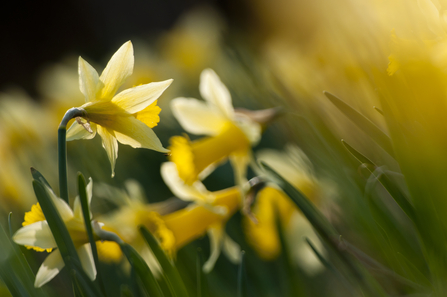
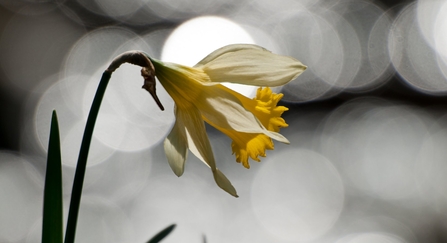
Wild daffodils have a more delicate beauty than their cultivated cousins: smaller and subtler, their trumpets are lemon hued, with petals the colour of clotted cream.
Ross Hoddinott/2020VISION
Ross Hoddinott/2020VISION
©Ross Hoddinott/2020VISION
Find wild daffodils near you
Do a little research in advance and find out where you can see a display of wild daffodils. Several Wildlife Trusts manage nature reserves where wild daffodils grow and here we list a few, including several in 'the Golden Triangle' – an area of north west Gloucestershire famous for its displays of wild daffodils.
North
Cumbria, Howe Ridding Wood Nature Reserve - The most northerly part of Witherslack Woods, a large expanse of ancient woodland on the western side of Whitbarrow Scar. Much of the nature reserve overlies the same Carboniferous limestone which forms the Scar. In spring see wild daffodil, bluebell, damson and apple blossom and the beautiful pearl bordered fritillary butterfly.
South
Devon, Dunsford Nature Reserve - One of the best places to see daffodils in South West England. Coach loads of people used to come to the reserve to pick daffodils and the site became so popular that signs had to be put up asking people not to remove the flowers. Thankfully Dunsford remains a great place to see wild daffodils today.
Gloucestershire, Gwen & Vera's Fields - Less than a mile away from Betty Daw's nature reserve and although very small, includes one of the few remaining wild daffodil meadows in north west Gloucestershire.
Gloucestershire, Vell Mill - Predominantly managed as a wild daffodil meadow, although other species such as cowslip, hoary plantain, common dog-violet and meadow vetchling can also be found here.
Gloucestershire, Ketford Banks - A small and steep, sandy bank, famous for its display of wild daffodils. The Trust acquired the site in 2010 and much removal of scrubby species including bracken has been undertaken to encourage the wild daffodils to thrive.
Herefordshire, Lea and Pagets Wood - Wild daffodils are not restricted to Wordsworth’s Lake District; Herefordshire holds its own treasures. Lea and Pagets Wood – one of the finest, ancient, semi-natural broad-leaved woodlands left in the Wye Valley – is a place where golden clumps of wild daffodils contrast with the bluebells carpeting the woodland floor. Birdlife is abundant with all three species of woodpecker, while the wood is an excellent place for mammals, including dormouse, woodmouse, yellow-necked mouse and bank vole.
Herefordshire, Wessington Pasture - The Herefordshire borders walked by the Dymock Poets are renowned for their daffodils. When the M50 motorway was constructed, wild daffodil bulbs were saved from the site and transplanted to Wessington Pasture, one of our nature reserves on the Woolhope Dome. A number of other interesting plants found here include dwarf thistle, adder's tongue, and autumn ladies tresses.
Herefordshire, Quebb Corner - Wild daffodil can be found in good numbers growing beside the old hedgerows at Quebb Corner, suggesting the hedge may be a remnant of an ancient wood. The drier areas of the meadow are characterised by crested dog's-tail grass with large amounts of common knapweed. Look out too for rarer speices, including pale sedge and greater butterfly orchid.
Hertfordshire, Stocking Springs Wood - Nestled amongst the wooded estates of central Hertfordshire, this small hornbeam wood is a beautiful example of traditional coppice management and hosts a wonderful display of wild daffodils in the spring. Also present are bluebells, wood anemones and wood violets. Oak trees amongst the hornbeam provide nesting for great spotted woodpeckers, nuthatches and treecreepers.
Wiltshire, Oysters Coppice Nature Reserve -Dainty wild daffodils grow in this ancient woodland nature reserve overlooking the Vale of Wardour, near Shaftesbury. Other woodland wildflowers, including bluebells, wood anemones, primroses and wood sorrel ensure a spectacular display for any visitor. Also keep your eyes peeled for the interestingly shaped moschatel – otherwise known as the ‘town hall clock’
Midlands
Staffordshire, George's Hayes - Consisting of two separate woodland blocks, George's Hayes is an ancient woodland in Staffordshire and is best known for its native wild daffodils.
Warwickshire, Harvest Hill - A charming meadow near the village of Allesley, noted for its beautiful display of wild daffodils. With the onset of spring comes a carpet of yellow heads raising their faces to the sun: a sight that would cheer anyone out of the cold of winter. The meadow is seasonally grazed by a small flock of Hebridean sheep in order to maintain the meadow and ensure the survival of the stunning wild daffodils.
Wales
Glamorgan, Coed y Bwl - Famous for its daffodil displays. Previously commended in the Vale of Glamorgan Biodiversity Partnership’s Awards for Wildlife, the reserve’s prime conservation target is the safeguarding of Coed-y-Bwl’s locally-rare wild daffodil population in the wake of Dutch elm disease which ravaged the wood over thirty years ago.
Islands
Isles of Scilly Wildlife Trust - The Scilly climate is often much milder than on mainland UK, meaning that daffodils came into flower much sooner than they did elsewhere in the UK. They have a long history of growing Narcissi commercially, to be picked and sold to those who wanted them on the mainland. It’s quite difficult to walk around much of Scilly without seeing one of several different varieties that are grown on the islands. As more than 50% of the islands are cared for by the Trust it’s common to find them on land that is managed by the team and they are a true sign that spring is well on its way.
What to look for
The sight of a wild daffodil trumpets the arrival of spring, and whether you’re in a meadow or woodland there will be plenty of other things to see and hear at this time too. Look out for primrose and newly arrived migrant bird species like the blackcap, wood warbler, nightingale and chiffchaff. The wonder of daffodils isn’t just about the colour, try lowering yourself to their level and watch them bob and shimmy in the breeze.
If you can't get to a wild daffodil site
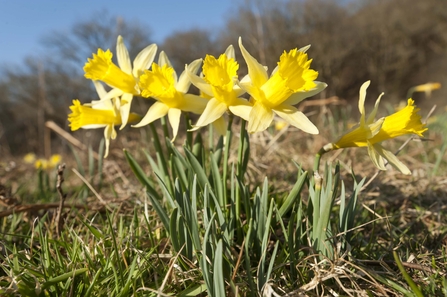
If there isn’t a place where wild daffodils grow in profusion near you, look out for them on rural roadsides. Wild daffodils have narrow, grey-green leaves and the familiar daffodil-shaped flower: pale yellow petals surrounding a darker yellow trumpet. This two-tone look is one way to tell them apart from their garden relatives. Wild daffodils are also relatively short and form clumps, carpeting the ground.
More wildlife experiences
From seeing colourful wildflowers to spotting magnificent birds of prey, we can help you get closer to wildlife across the UK.


